


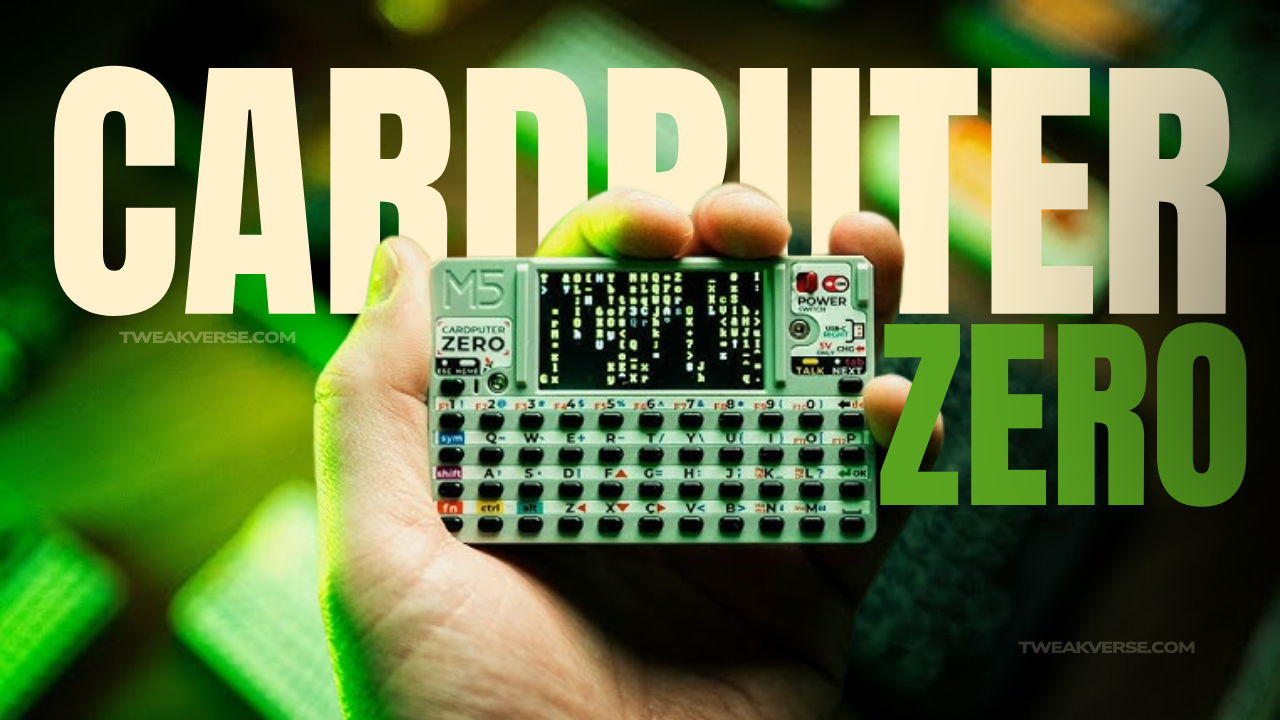
There’s a new gadget making the rounds in the maker community right now, and it’s got a name that sounds like a typo the first time you read it: CardputerZero. If you’ve been anywhere near M5Stack’s socials, Kickstarter feeds, or a maker Discord in the last few months, you’ve probably already seen it — a credit-card-sized computer that actually runs full Linux instead of just a microcontroller sketch.
I’ll be upfront about something before we dive in: I don’t have a unit in my hands yet. I’ve reached out directly to the M5Stack team and requested an engineering sample so I can put together a proper, detailed hands-on review — real boot times, real battery drain numbers, real “does the keyboard actually feel good after an hour of typing” kind of testing. The moment that sample lands on my desk, I’ll be updating this piece (or writing a follow-up) with everything I find, good and bad. Until then, consider this your organized rundown of what’s publicly known about the CardputerZero, why it’s generating so much buzz, and what to actually watch for before you back it or buy it.
What Exactly Is the Cardputer Zero?
CardputerZero is the newest entry in M5Stack’s Cardputer lineup, and it’s a genuine departure from everything that came before it. The original Cardputer and the Cardputer Adv were both built around Espressif’s ESP32 microcontrollers — great for embedded projects, IoT experiments, and lightweight scripting, but not something you’d call a “real computer.”
CardputerZero changes that equation entirely. Instead of an ESP32, it’s built around the Raspberry Pi Compute Module Zero (CM0), which means it’s running an actual quad-core Cortex-A53 processor capable of booting a full Linux distribution. In plain terms: this isn’t a microcontroller board pretending to be a computer. It’s a pocket-sized Linux machine with a keyboard bolted on.
M5Stack is marketing it as a “pocket Linux lab,” and functionally that tracks — CLI access, SSH, on-device AI workloads, and a built-in app store for community firmware, all without needing a PC to reflash or configure anything.
Key Specs Worth Knowing
Based on what M5Stack has published so far, here’s the spec sheet that matters:
- Processor: Raspberry Pi Compute Module Zero (CM0), quad-core Cortex-A53
- Display: 1.9-inch built-in screen
- Keyboard: 46-key physical keyboard
- Camera: 8MP (full version only)
- Sensors: Built-in IMU and RTC (full version only)
- Connectivity: Wi-Fi, Bluetooth, and 10/100M Ethernet
- Storage: microSD expansion (32GB card bundled with the full version)
- USB: Switchable USB host/device interface
- Battery: 1500mAh
- Dimensions: 84×54mm — essentially the footprint of a standard credit card
- Expansion: Compatible with over 100 existing M5Stack modules, plus dedicated add-ons like a CC1101-based sub-GHz/NFC cap and a LoRa cap for mesh networking experiments
There’s also a stripped-down CardputerZero Lite variant that drops the camera, IMU, and bundled microSD card to bring the price down.
Why This Launch Is a Big Deal
A few things make CardputerZero stand out from the flood of “pocket Linux device” projects that show up on crowdfunding sites every year:
It’s genuinely pocketable. Credit-card dimensions aren’t just a marketing line here — this thing is meant to disappear into a jacket pocket, not just a backpack.
It leans on the existing Cardputer ecosystem. Because it’s part of the Cardputer family, it inherits compatibility with the huge library of M5Stack expansion modules that have built up around the ESP32-based versions. That’s a real advantage over a from-scratch device with zero accessory support at launch.
It’s aimed at actual workflows, not just novelty. SSH access, Python development, command-line tools, hardware prototyping, wireless protocol research, network diagnostics — this is being pitched at makers and developers who want field-ready Linux, not just a toy.
The crowdfunding numbers back up the interest. The Kickstarter campaign has pulled in well over a million dollars from more than ten thousand backers against a modest original funding goal, which says a lot about pent-up demand for something in this exact category.
Who Is CardputerZero Actually For?
If you’re the kind of person who wants a truly portable SSH terminal, a device for on-site troubleshooting and field diagnostics, a compact platform for embedded development, or a sandbox for wireless and RF experimentation (especially with the optional sub-GHz and LoRa caps), this is squarely built for you. M5Stack is also positioning it as capable of lightweight entertainment — think simple games and MP3 playback — as a bonus rather than the main pitch.
It’s probably not the right pick if you just want a beginner-friendly microcontroller board for a first Arduino-style project. For that, the original ESP32-based Cardputer or Cardputer Adv is still the simpler, cheaper entry point.
Pricing and Availability
Pricing has been positioned around a Super Early Bird tier for the full version, with the Lite version sitting well below that. As with most crowdfunding campaigns, expect the price to climb once the early bird and Kickstarter-exclusive tiers sell out, with general retail availability following months after backers receive their units.
What I’m Watching For Once I Get My Hands on One
Specs on a product page only tell you so much. Once my engineering sample request comes through, the things I actually want to test and report back on are:
- Real boot time and day-to-day responsiveness running a full Linux desktop or CLI on the CM0 chip
- Actual battery life under mixed use — SSH sessions, camera use, and idle standby
- Keyboard feel during longer typing sessions on a 46-key layout this small
- Thermal behavior when the CPU is under sustained load in such a compact enclosure
- How mature the community firmware and app store actually are at launch versus how it’s being marketed
I’ll fold all of that into an updated hands-on review the moment the sample arrives. For now, this covers everything that’s publicly confirmed about CardputerZero — bookmark this page if you want the fuller picture once real-world testing is in.
Have questions about CardputerZero or want me to test something specific once I get the engineering sample? Drop them in the comments and I’ll try to cover it in the follow-up review.